

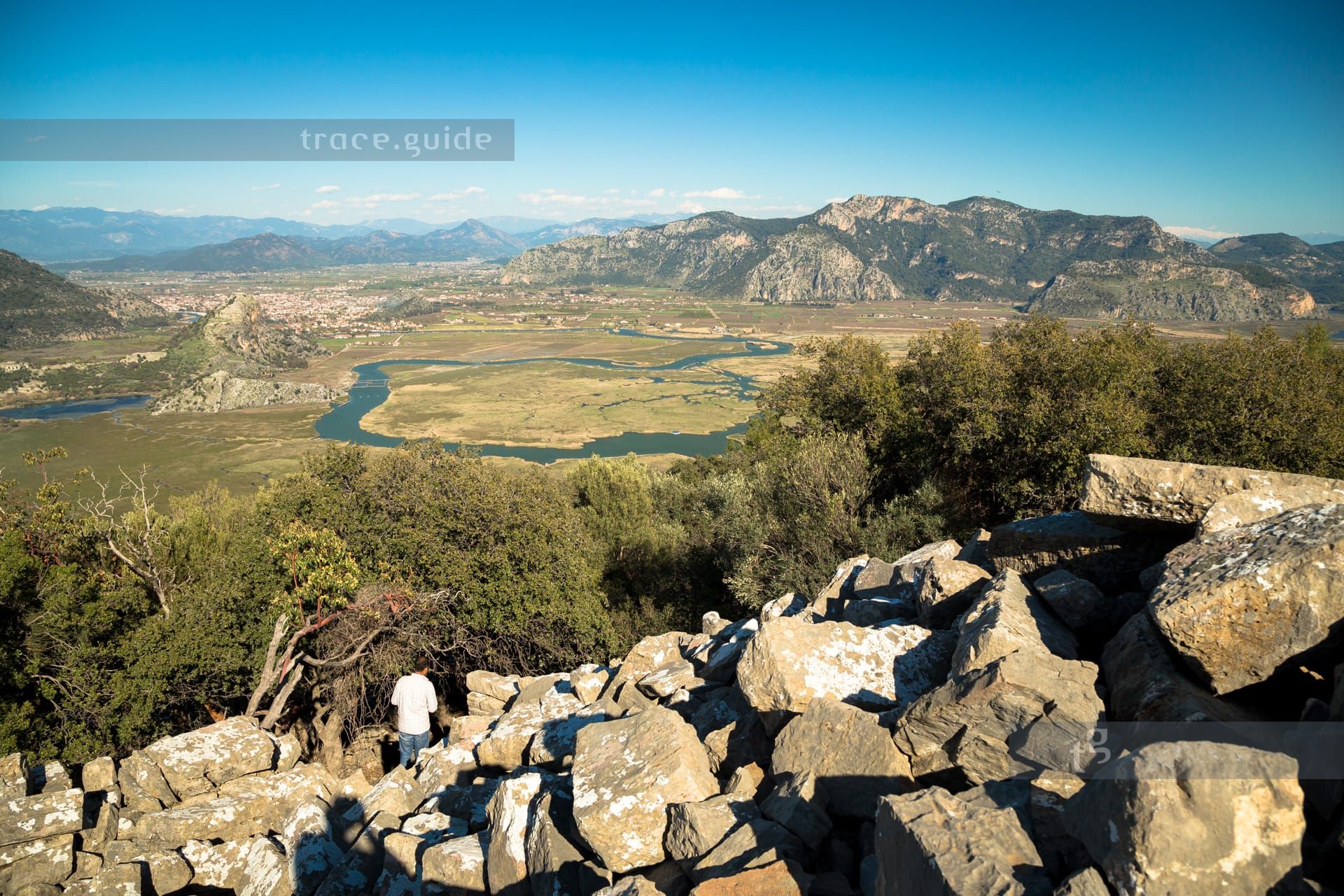
More than one visit is needed to fully appreciate the diversity of the ancient Caunus area. The balance between areas marked with information signs, some restricted, and freely accessible, almost undeveloped terrain where one must find their own path, creates a sense of untouched nature.
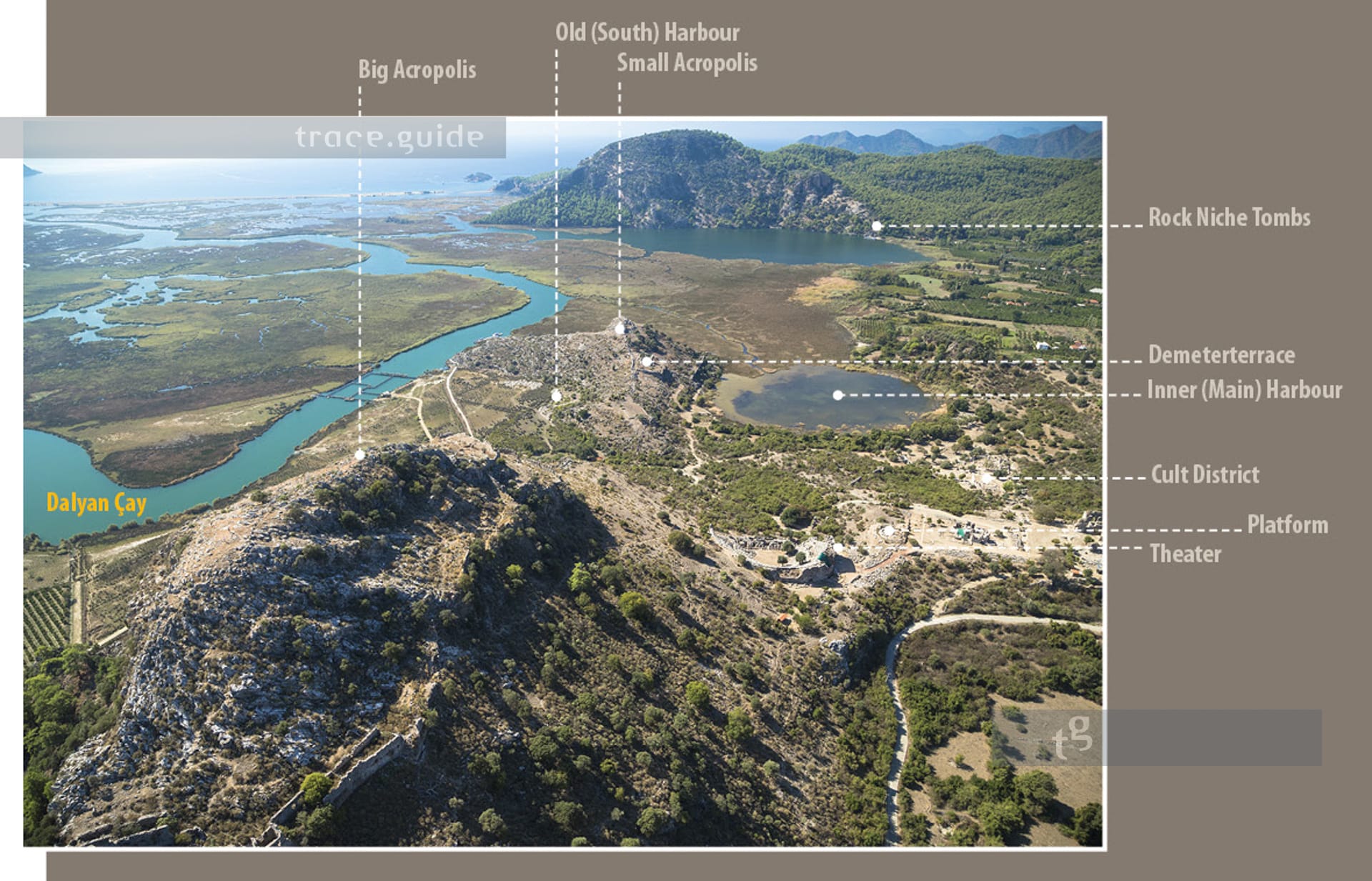
It is worthwhile to familiarize oneself with the topography and structural features before the first visit: for instance, to reach the impressive city wall that climbs over one kilometer up the northern slope to 200 meters in elevation, where no designated path exists. Or the Demeter Terrace, located south of the old harbor basin on the imposing rock that separates the old harbor from the round basin, which is considered one of the most original cult places in Caunus.
In front of this rock, also called the small Acropolis, there is a docking station for the riverboats of the delta, a recommended way to reach Kaunos and understand what led to the demise of this polis. Like many deltas along the coast, it was siltation and, in its later phase, the increase in swamp areas and mosquitoes spreading malaria that were the culprits. Mosquitoes are scarcely a problem today, and malaria was eradicated in the 1940s. From antiquity, the geographer and historian Strabo recounts an anecdote from the Hellenistic period concerning the health conditions in Caunus: „How can I dare to call a city unhealthy, where even the dead still walk the streets?“ It was a response to the excitement of the Caunians when the protagonist mocked the green faces of the residents, comparing them to the falling leaves of a tree.
Due to the geology of the area, hot sulfur springs emerge above the delta on the southern shore of Köyceğız Lake, where the river connects the lake with the delta. These springs were used in antiquity and are still considered healthful today. Nowadays, the delta is a natural paradise; blue crabs are caught and prepared directly on the riverboats, a nearly 4km long sand dune with designated conservation areas for sea turtles separates the delta from the sea. Trapped fish and dried fish roe are omnipresent in Dalyan, separated from Caunus by the river.